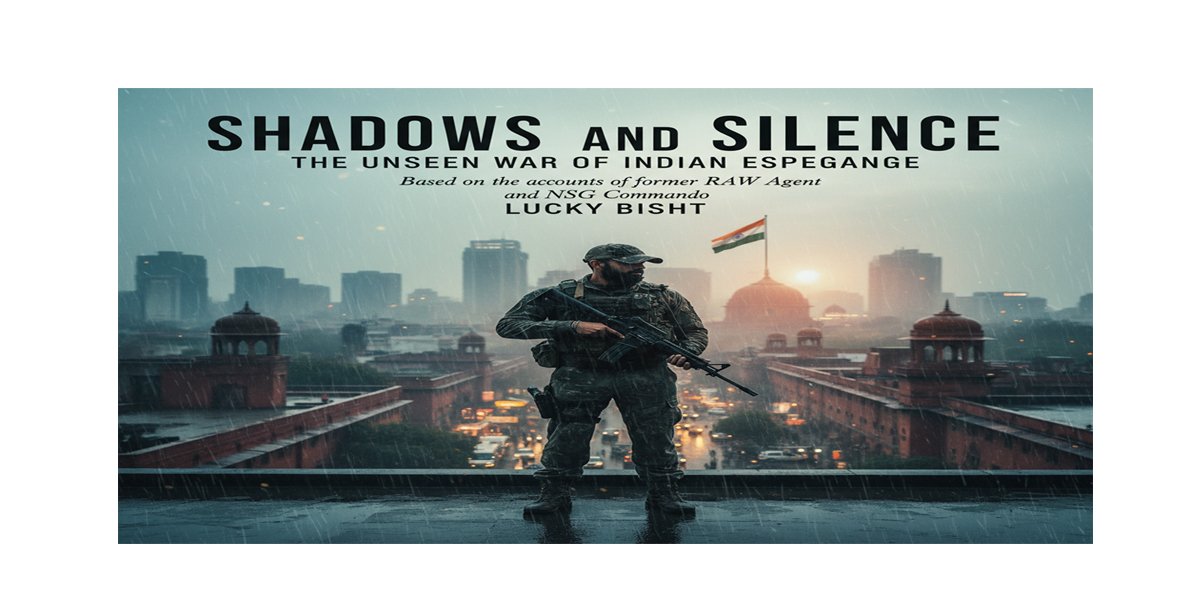
Lucky Bisht, a former National Security Guard (NSG) commando, spy, and hitman for India’s Research and Analysis Wing (RAW), recently pulled back the curtain on this clandestine world. His account offers a chilling, gritty, and deeply patriotic glimpse into how India protects its borders—not just with soldiers in daylight, but with ghosts in the dark.
The Silent War
Bisht describes the world of intelligence as a state of perpetual warfare. While history books record the wars of 1962, 1971, and 1999, intelligence agencies operate in a conflict that has no start or end date. "You are never safe," Bisht notes. "The enemy isn't just at the border; they could be inside your home."
In this geopolitical chessboard, agencies like the CIA (USA), Mossad (Israel), and ISI (Pakistan) are locked in a fluid dynamic. Bisht operates on a single, cold principle: There are no permanent friends, only temporary alliances. Agencies collaborate solely to weaken a mutual enemy. Once the objective is achieved, the handshake ends, and yesterday’s ally may become tomorrow’s target.

However, Bisht distinguishes RAW from its global counterparts through its operational ethics. While agencies like the CIA and Mossad are known for aggressive tactics that often result in high collateral damage—Bisht cites the CIA’s destabilization of over 51 governments—RAW operates with a "scalpel" rather than a hammer. The Indian doctrine prioritizes the safety of innocents. "We will let an enemy escape to fight another day rather than risk the life of a single innocent child," Bisht asserts.
This subtlety is why RAW’s victories go unsung. From the 1974 nuclear tests conducted under the nose of American satellites to Operation Meghdoot in Siachen, India’s successes are shrouded in silence.
The Psychology of a Ghost
What does it take to become an agent? According to Bisht, it isn't about muscle or marksmanship—those can be taught. It is about integrity.
"If you are a truly honest patriot, RAW will find you. You don't find them," he says.

Once inside, the training rewires the human mind. The most essential skill for a field agent is the ability to live a lie so completely that it becomes the truth. Bisht explains that an agent must be able to convince their own soul of their cover identity. If an agent is captured and subjected to a polygraph test, they don't beat the machine by tricking it; they beat it by genuinely believing their own fabrication.
This life requires a "compromise mindset." Trust is a liability. Every asset, every source, and every contact is viewed through the lens of potential betrayal. Paranoia isn't a disorder for a spy; it's a survival mechanism.
The Sniper’s Code: One Bullet, One Commander
Bisht’s career also saw him designated as one of the world’s top snipers, a role that demands a unique physiological and psychological state.
"Shooting is easy," Bisht remarks. "Finding the target is the hard part."
A sniper does not hunt foot soldiers; they hunt leadership. The motto is "One bullet, one commander." By decapitating the command structure, a single sniper can render an entire enemy battalion directionless. This requires a level of patience that defies normal human limits—lying in the dirt for days, ignoring hunger, weather, and insects, waiting for a single window of opportunity. At the moment of the shot, the sniper’s mind and eye must align perfectly, blocking out the chaos of the world to focus on a single point.
Bisht also touched upon the lethal efficiency of unarmed combat, referencing the "3-second kill"—a technique to snap the spinal cord in micro-seconds. It is a grim reminder that in his line of work, the body itself is a weapon as deadly as any rifle.
The Jungle Behind Bars
Perhaps the most jarring chapter of Bisht’s life was the four years he spent in an Indian prison, facing allegations he claims were politically motivated and fueled by the ISI.
He describes Indian jails as a "jungle" with its own economy and hierarchy. In this underworld, respect is dictated by the severity of one's crime. A petty thief is nobody; a man with multiple murders is a king.

Bisht exposes the rot of corruption within the system, where gangsters run empires from their cells, buying luxury food and smartphones for exorbitant prices (he recalls a ₹9,000 phone costing ₹3 lakh inside). Yet, he strips away the glamour of the "gangster" lifestyle. He recounts a conversation with a feared Don who admitted, "The truth is I am terrified. The lie is that I am a Don."
Bisht’s message to the youth is clear: do not idolize these criminals. Their power is a facade, and their end is always a lonely, dark cell, far from the parents who weep for them in police stations.
The Modern Threat: Honey Traps and Vices
In the modern era, the threats have evolved. Bisht warns of the "Honey Trap," a tactic as old as time but deadlier than ever. These are not fleeting encounters; a foreign agent may marry a target, live with them for 30 years, and raise children, all while siphoning secrets.
To survive this world, Bisht adheres to a strict code to avoid the three vices that kill agents: Nasha (Intoxication), Lalach (Greed), and Ladki (Lust). Control over these impulses is the only armor an agent has.
Conclusion
Lucky Bisht’s story is a testament to the men who stand on the wall while the nation sleeps. It is a life of immense sacrifice, where the victories are secret, the failures are fatal, and the only reward is the silent satisfaction of duty done.
As Bisht signs off, his final wish is not for glory, but for peace—a "Sukoon" (tranquility) that is rare in a life lived in the crosshairs.
Comments
Leave a Comment
No comments yet. Be the first to share your thoughts!