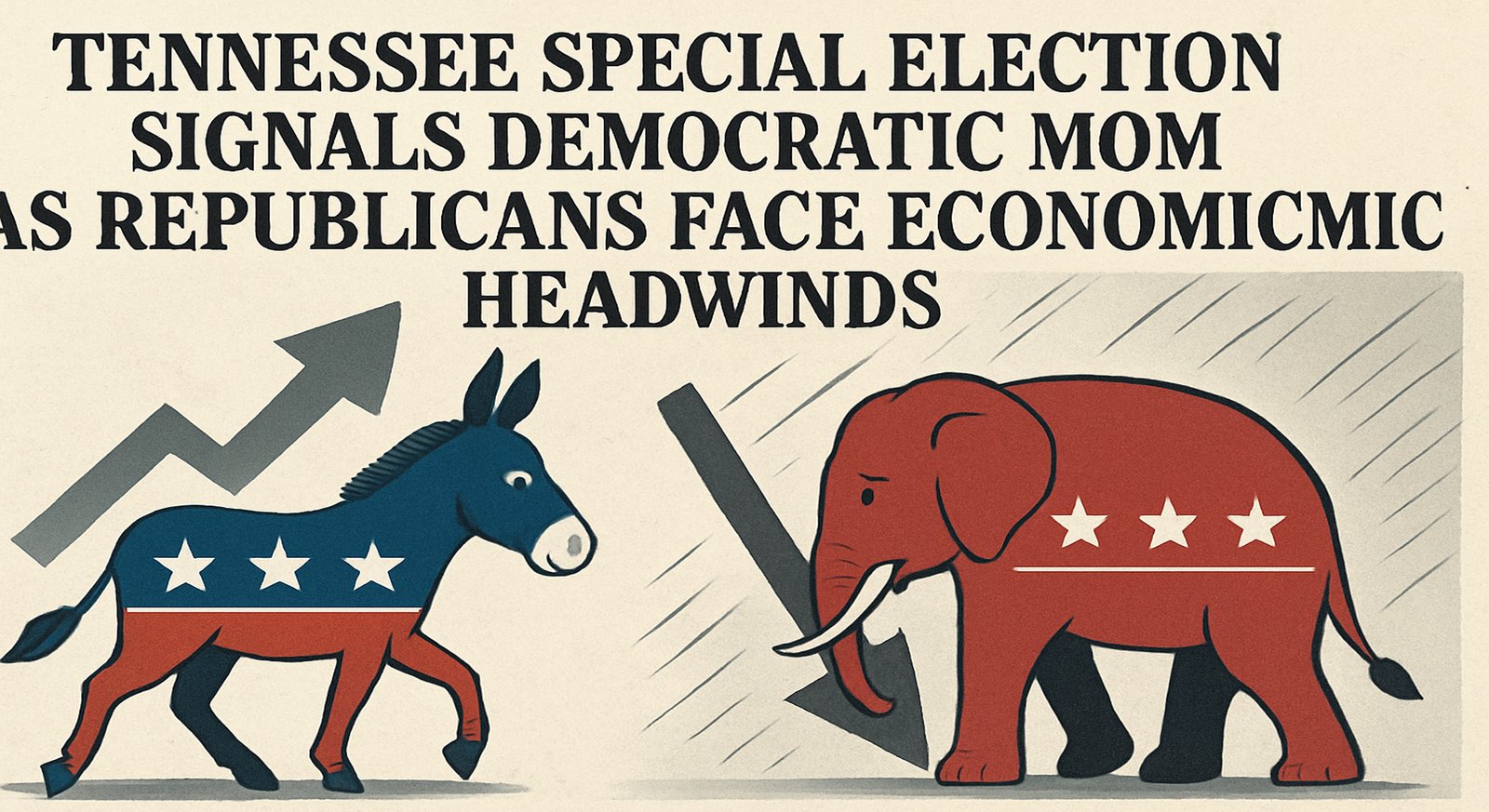
Tennessee’s result fits right in with what we’ve seen all through 2025—Democrats keep beating the odds, and not by a little. We’re talking double-digit wins. Just a few weeks ago, they pulled off big victories in Virginia, New Jersey, California, and Pennsylvania. Those wins got people fired up, especially Democrats who suddenly saw the midterms in a whole new light. So, what’s tying all these races together, whether it’s for governor or Congress? It’s not complicated. People are worried about money. The cost of living is sky-high, and economic anxiety is everywhere. That’s what’s driving voters this year.

The Tennessee special election looked simple enough at first. Republicans thought they had it in the bag—after all, Trump won the district by 15 points in 2020, and stretched that lead to 22 points by 2024. Nobody expected a real fight. But once voting got underway, it was clear things weren’t going as planned. Suddenly, both parties realized the race was much tighter than they’d guessed. Republicans scrambled, bringing in national groups and dropping about $4 million into the campaign in the final weeks.
In the end, Van Epps pulled off a win with 51.6 percent of the vote, while Behn grabbed 42.7 percent. Sure, a win’s a win, but that slim margin set off alarms inside the Republican camp. GOP strategists saw this as a warning sign—a glimpse at how rough next year’s midterms could get. Senator Ted Cruz didn’t sugarcoat it. He called the race “perilous,” echoing the worry running through party leaders. If they’re barely squeaking by in a district this red, holding onto the House with just a three-seat cushion suddenly looks a lot tougher.

Aftyn Behn built her campaign around a simple idea: get rid of Tennessee’s grocery tax. At 4 percent, it’s one of the highest in the country, and people notice. Sure, the Republican-controlled legislature shot down her plan, but she stuck with it, making it the heart of her run for Congress. That focus seemed to hit home with voters worried about making ends meet. Van Epps ended up winning, but Democrats still found something to celebrate—they closed the gap by 12.6 percentage points compared to last year. That’s a big jump.
Turnout looked more like a midterm than your usual sleepy special election. That alone says something. When you put the higher turnout together with the improved Democratic numbers, it looks like Democratic voters are showing up more than Republicans in these off-year races. And honestly, that’s been the story all through 2025.
This election fits a bigger pattern we’re seeing this year: people care more about their wallets than about party loyalty. Even though Trump got his win in Tennessee, the tight race and the issues that grabbed everyone’s attention—grocery prices, rent, healthcare—tell you what’s really on voters’ minds.

Broader Political Implications and 2026 Outlook
The results in Tennessee just add fuel to the fire when it comes to talk about the 2026 midterms. Democrats have been on a roll lately—they've notched double-digit gains in several races, averaging a 14-point bump over what people expected based on 2024 numbers. This has shown up especially in the governor’s races in New Jersey and Virginia. If they keep this up, Democrats are in a strong spot to take back the House, since Republicans only hang on by three seats right now.
But Republicans aren’t just sitting back. They’ve been going all in on redistricting. In December, the Supreme Court—6-3, conservative majority—let Texas move forward with a new congressional map, even though lower courts said it was illegal racial gerrymandering. Trump has already said this map could mean five more Republican seats.
Democrats aren’t letting that slide. In California, voters passed Proposition 50, which could hand Democrats control over redistricting and possibly give them five more seats—basically erasing the gains Republicans expect in Texas. Governor Gavin Newsom is pushing other blue states to do the same. So now we’re seeing a full-on “redistricting arms race” between the two parties.
The Economic Challenge for Republicans
Beneath all the talk about Tennessee and the midterms, there’s a big problem for Republicans: the economy. The mood out there isn’t great, and it’s shaping how people plan to vote. Gallup’s latest numbers paint a rough picture for the GOP going into 2026—economic confidence just hit a 17-month low. Only 27% of people think things are getting better, and a whopping 68% say the economy’s getting worse.
Inflation’s really sticking with voters. An ABC/Ipsos poll from last month found that 70% of people are spending more on groceries, and most are seeing higher bills for utilities, housing, and healthcare, too. Even among Trump’s base, about 40% told Politico/First they feel the cost of living is higher than ever—and they blame the president for it.

Trump’s take on the economy is, well, pretty blunt. Instead of offering up fixes for rising costs, he’s called all the talk about inflation a “con job” cooked up by Democrats. During a Cabinet meeting, he claimed, “This fake narrative that the Democrats talk about—affordability. They just say the word; it doesn’t mean anything to anybody. I inherited worst inflation in history. There was no affordability; nobody could afford anything.”
But if you ask voters, they’re not exactly buying it. A recent Economist/YouGov poll found that three out of four people think Trump’s policies made them pay more—including most Republicans. And when it comes to tariffs, only 13 percent want to see them go up, even though Trump’s team has rolled out new ones.
Campaigns are catching on. Some Republican candidates are starting to break away from Trump’s shrug-it-off attitude about the economy. In Tennessee, Van Epps ended his campaign talking about the cost of living, following Behn’s lead on pocketbook issues, even though he had a partisan edge. Basically, more GOP candidates seem to realize that if they ignore voters’ money worries, they’ll pay for it at the polls.
Big picture, voters aren’t sticking to party lines when the economy looks rough. Sure, Republicans usually see higher turnout when Trump’s name is on the ballot, but since 2017, off-year elections have been swinging toward Democrats. And with Trump nowhere on the 2026 ballot, Democrats are likely to have the upper hand.
There’s more: several Republican House members have already said they’re not running again. It’s a clear sign the GOP is nervous about 2026. If Democrats can find strong candidates to fill those open seats, their odds of making gains go up even more.

Demographic Shifts and Latino Support
There’s another headache for Republicans coming out of the 2025 elections: Latino voters are slipping away. Trump made real gains with Latinos in 2024, and a lot of pundits thought he’d cracked the code for the GOP. But now? The 2025 special elections and off-year races tell a different story. In Virginia and New Jersey, Latino voters went for Democratic candidates two-to-one—a big swing from Trump’s numbers just a year earlier.
Look at South Texas. Republicans thought Latinos there would stick with Trump, but recent polling shows that support fading fast. People aren’t happy with the way Trump handled the economy, and they haven’t forgotten his tough stance on deportations. The very voters he worked so hard to win in 2024 are starting to drift away.
Conclusion: An Uncertain Path Forward
The Tennessee special election is about more than just another notch in the GOP’s belt. Republicans only squeaked out a win after pouring in money and national attention—hardly what you’d expect from a supposedly safe seat. It’s a sign that the ground is shifting for both parties. Democrats, fired up by economic frustration and the wins they racked up in 2025, are eyeing even bigger gains in 2026.
Republicans have their work cut out for them. The House majority hangs by just three seats. Redistricting battles are getting tougher. Voters are worried about the economy, and the president isn’t really addressing those fears. If things don’t turn around soon—or if Trump doesn’t start speaking directly to what’s on people’s minds—Republicans are in for a rough ride heading into the 2026 midterms.
Tennessee’s result says it all: what once looked like a guaranteed Republican win is anything but. With the House so closely divided, a few more surprises like this could flip the whole chamber.
Comments
Leave a Comment
No comments yet. Be the first to share your thoughts!